The Bucket Strategy for Retirement: How to Stop Losing Sleep Over Your Money

You've spent decades saving for retirement. But actually spending that money? That's a whole different kind of stress. The bucket strategy gives you a framework so you never have to sell stocks in a crash — and might finally let you sleep through the night.

- Bucket 1 (1–3 years): Cash and money markets — pays your bills right now.
- Bucket 2 (4–10 years): Bonds and income funds — the bridge that refills Bucket 1.
- Bucket 3 (10+ years): Stocks and index funds — your growth engine. Don't touch it in a downturn.
- The key: When markets crash, you spend from cash while stocks recover. No panic selling.
Bottom line: The bucket strategy may not be mathematically perfect, but it's the plan you'll actually stick with when things get ugly.
So you've been stacking bread for decades. Nice. But here's the thing nobody warned you about — actually spending that money? That's a whole different kind of stress.
I'm not being dramatic. Markets drop 20% and suddenly you're wide awake at 2am doing mental math like some kind of deranged accountant. Should I cancel the trip? Eat more ramen? Go back to work at 68? My friend Mark went through exactly this in early 2020 — guy had plenty saved, but he was genuinely panicking because he had no plan for how to use it.
The bucket strategy fixes that. It won't make you richer than some perfectly tuned spreadsheet portfolio (and I'll be honest about that later), but it might be the thing that actually lets you enjoy retirement instead of stress-eating every time CNBC flashes red.
Here's how it works, and more importantly, how to actually set it up with real money in real accounts.
The 3-Bucket Strategy: How It Works
The concept is dead simple: split your retirement money into three buckets based on when you need it. A financial planner named Harold Evensky came up with the original "cash reserve" idea, and since then folks like Christine Benz at Morningstar and Fritz Gilbert over at The Retirement Manifesto have turned it into something really practical.
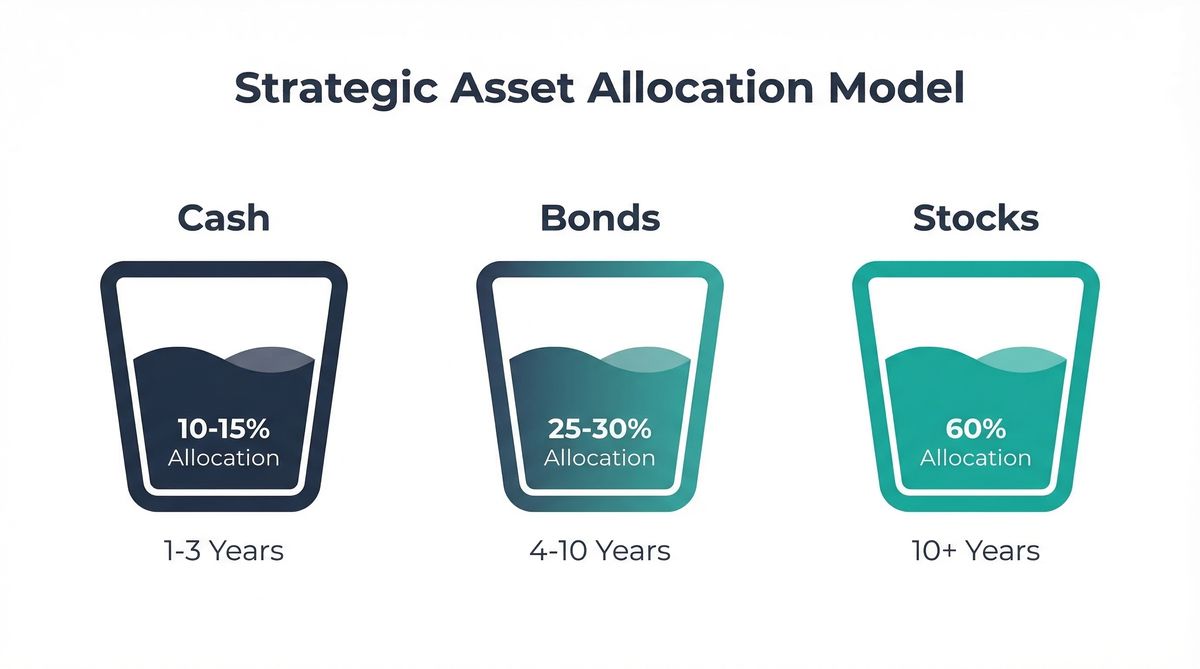
Bucket 1 — Your "Right Now" Money (1–3 years of expenses). Cash. Straight up. This is what pays your bills. You don't care if the stock market is having a meltdown because this money was never in the stock market to begin with.
Bucket 2 — The Bridge (4–10 years of expenses). Mostly bonds and income-producing stuff. Its whole job is to refill Bucket 1 when the time comes. Boring? Yep. That's the point.
Bucket 3 — The Growth Engine (10+ years). Stocks. Index funds. The stuff that actually grows your money over time. You don't touch this when markets are down. You just... let it cook.
When the market tanks — and trust me, it will — you're spending from cash. You've got years of runway before you'd ever need to sell stocks at a loss. That buffer is everything.
Why the Retirement Bucket Approach Matters (Sequence of Returns Risk)
Here's something that blew my mind when I first learned about it. Two retirees can earn the exact same average return over 20 years and end up with completely different amounts of money. How? It's all about when those returns happened.
Definition: Sequence of Returns Risk
The risk that the timing of poor investment returns early in retirement will permanently damage your portfolio — even if long-term average returns are solid. It's the single biggest mathematical threat to early retirees.
Picture this: two people both start with a million bucks, both pull out $50,000 a year, both average 7% returns.
Lucky Sequence
- Starting Balance $1,000,000
- Annual Withdrawal $50,000
- Average Return 7%
- Early Returns Strong
- Balance After 20 Years $674,000+
Unlucky Sequence
- Starting Balance $1,000,000
- Annual Withdrawal $50,000
- Average Return 7%
- Early Returns Poor
- Balance After 20 Years ~$146,000
Same average. Wildly different outcomes. That's not even a hypothetical — it's math.
The retirement bucket approach tackles this head-on because you're never forced to sell stocks during a downturn just to keep the lights on. The average bear market since World War II has lasted about 14 months. If you've got 2–3 years in cash and another 4–8 years in bonds, you can ride out pretty much anything without touching your stocks. That's one excellent safety net.
What to Put in Each Retirement Bucket (Real Funds, Not Vague Advice)
This is where most articles get useless. They say "put cash in Bucket 1" and call it a day. Cool, thanks, super helpful. Here's what you actually buy.
Bucket 1: Your Spending Money (1–3 Years)
Safety and access. That's all we care about here.
- High-yield savings — Ally, Marcus, Wealthfront Cash, whatever's paying the best rate right now
- Money market funds — Vanguard Federal Money Market (VMFXX) or Schwab Value Advantage
- Short-term CD ladders — 3-month, 6-month, 12-month CDs on a rolling basis
- Treasury bills — Buy through TreasuryDirect or your brokerage
- I Bonds — Great for inflation protection, but 1-year lockup and $10K annual cap per person
If you're spending $50K a year from your portfolio, Bucket 1 holds roughly $100K–$150K.
Bucket 2: The Bridge (4–10 Years)
Stability with a little growth. Enough to keep up with inflation, not so much that it'll give you a heart attack in a downturn.
- Vanguard Total Bond Market ETF (BND) — Broad bond exposure, the bread and butter
- Vanguard Short-Term Bond ETF (BSV) — Less sensitive to interest rate swings
- TIPS (Treasury Inflation-Protected Securities) — Built-in inflation hedge
- Vanguard Dividend Appreciation ETF (VIG) — Solid companies that keep raising dividends
- Municipal bond funds — Tax-free income if you're in a higher bracket
Same $50K/year person? Bucket 2 holds about $200K–$300K.
Natural Refilling
Christine Benz at Morningstar points out that income from bonds and dividends in Bucket 2 naturally helps refill Bucket 1 over time. Less selling, less hassle.
Bucket 3: The Growth Engine (10+ Years)
This is where you stay aggressive. You're not touching this for a decade-plus, so let it ride.
- Vanguard Total Stock Market ETF (VTI) — The whole U.S. stock market. One fund. Done.
- Vanguard S&P 500 ETF (VOO) — Big U.S. companies
- Vanguard Total International Stock ETF (VXUS) — Because America isn't the whole world
- Small-cap value funds — Historically juicier returns over long periods
Roughly 60% of your portfolio lives here.
| Bucket | Time Horizon | Purpose | Key Holdings | Portfolio % |
|---|---|---|---|---|
| 1 — Cash | 1–3 years | Pay the bills | HYSA, VMFXX, T-Bills, CDs | ~10–15% |
| 2 — Bridge | 4–10 years | Refill Bucket 1 | BND, BSV, TIPS, VIG | ~25–30% |
| 3 — Growth | 10+ years | Long-term growth | VTI, VOO, VXUS | ~60% |
Tax-Smart Bucket Placement (This Saves You Real Money)
Almost nobody talks about this in bucket strategy articles, and it drives me nuts because it makes a real difference in what you actually keep after taxes. Getting your retirement withdrawal strategy right means thinking about where each bucket lives, not just what's in it.
Bucket 3 (stocks) → Roth IRA. Your highest-growth stuff belongs where it'll never be taxed. Every dollar of growth in a Roth comes out tax-free. Put VTI, VXUS, and your most aggressive holdings here. Roth IRAs also don't have Required Minimum Distributions during your lifetime, so your growth engine just keeps compounding. Beautiful.
Bucket 2 (bonds) → Traditional IRA or 401(k). Bond interest gets taxed as ordinary income, which is expensive in a taxable account. Keep it in tax-deferred accounts and kick that tax bill down the road. Just know — RMDs start at age 73 (or 75 if you were born in 1960 or later), so you can't hide from the IRS forever.
Bucket 1 (cash) → Taxable brokerage account. Cash doesn't throw off much taxable income, and when you sell stuff here, you get the lower long-term capital gains rates (0%, 15%, or 20% depending on your income). Muni bonds work great here too since the interest is usually tax-free at the federal level.
Bonus Move: HSA as a Healthcare Bucket
If you've got a Health Savings Account, that thing is triple-tax-advantaged — deductible going in, grows tax-free, comes out tax-free for medical expenses. A 65-year-old couple is looking at an estimated $371,000 in healthcare costs during retirement ($185,500 per person, per Fidelity's 2026 estimate). An HSA is a beast for covering that.
Fritz Gilbert: 8 Years Living the Bucket Strategy
I love theory, but I love real-world proof more. Fritz Gilbert runs The Retirement Manifesto blog, and he's been living the bucket strategy since he retired in 2018. Eight years of data. Not a simulation — his actual life.
He started with roughly $1.5 million:
- Bucket 1: $150K in cash (3 years of spending)
- Bucket 2: $400K in bonds (8 years)
- Bucket 3: $950K in stocks
That's about 63% stocks, 27% bonds, 10% cash to start.
The Rising Equity Glide Path
Eight years later, Fritz's stock allocation has naturally drifted up to about 72%. Research from Michael Kitces and Wade Pfau shows this pattern — starting with less in stocks and gradually increasing — actually maximizes portfolio longevity. The bucket strategy creates it automatically.
Fritz rode out the 2022 bear market — when the S&P 500 dropped about 18% — without selling a single share. He spent from his cash bucket, did a partial refill from bonds, and kept living his life. No panic. No forced selling. No 2am cold sweats.
The guy spends fewer than 20 hours per year managing his whole portfolio. That's less time than I spent choosing a couch last year.
How to Refill Your Buckets: The Annual Check-In
This is where the rubber meets the road. Here's how it works in practice, largely based on Fritz's method:
Once a year, sit down and look at your buckets:
- How many years of spending are in Bucket 1? If you're below target (say 2 years), it needs a top-up.
- How'd the market do?
- Good year: Sell some winners from Bucket 3, refill Bucket 1 to your target. If you skimped on the refill last year, make up the difference now.
- Bad year: Don't sell stocks. Just don't. Move some money from Bucket 2 (bonds) to Bucket 1 instead. Accept that your cash reserve might be a little thin for a while. Markets recover. They always do.
- Check Bucket 2. If it got thin covering a bad year, plan to bulk it back up from Bucket 3 gains during the next good year.
Think in "years of spending," not percentages. Let your asset allocation be a result of managing your buckets, not the thing you're chasing.
How the Bucket Strategy Works With the 4% Rule
People ask me this all the time — does the bucket strategy replace the 4% rule? Nah. They do different jobs. The 4% rule tells you how much you can pull out each year. The bucket strategy tells you how to organize your money so those withdrawals don't force you into selling stocks at the worst possible time.
Use them together. Figure out your annual spending number (4% or whatever withdrawal rate makes sense for you), then build your buckets around that number. That's a complete retirement withdrawal strategy — how much and how.
The Honest Trade-Offs (Because Nothing's Perfect)
Look, I'm not gonna pretend this is some magic solution. Everything has trade-offs.
The nerds say it's slightly suboptimal. Javier Estrada did a study in 2018 — looked at bucket strategies versus simple rebalanced portfolios across 115 years of data in 21 countries. His finding? A plain old rebalanced 60/40 portfolio slightly edged out bucket strategies on pure numbers. Bucket approaches showed failure rates of 4–5%, while the rebalanced portfolio came in a bit lower. Fair enough. Though a lot depends on exactly how you run your buckets, and disciplined rebalancing closes most of that gap.
The math vs. your brain. Michael Kitces has pointed out that buckets and total-return approaches produce pretty similar results when you manage them well. The real difference is behavioral. Buckets give you a framework that stops you from doing something rash when you're scared — and honestly? That might be the most valuable thing about the whole strategy.
As Principal Financial Group put it: the bucket strategy offers clear psychological benefits, even if the pure financial edge over a simple approach is modest.
The Real Edge Is Behavioral
The best strategy is the one you'll actually stick with when things get ugly. A "mathematically optimal" plan that leads you to panic-sell during a crash is worse than a "good enough" plan that keeps you calm. Every time.
Dealing With RMDs in Your Bucket Strategy
One thing bucket strategy articles love to skip: if you've got money in traditional IRAs or 401(k)s, the IRS is eventually gonna make you take withdrawals whether you want to or not.
Under current rules (SECURE 2.0 Act), Required Minimum Distributions kick in at 73 if you were born between 1951 and 1959, or 75 if you were born in 1960 or later. The amounts go up every year.
Here's how to handle it within the bucket framework:
- Use your RMDs as a natural refilling mechanism. When the IRS forces you to pull from your traditional IRA (where Bucket 2 probably lives), funnel that cash into Bucket 1 or reinvest it in your taxable account.
- If your RMDs are more than you need for spending, invest the extra in your taxable brokerage — Bucket 1 or Bucket 3 assets, whatever you need.
- Roth conversions before RMDs start can shrink your future required withdrawals. That's a conversation worth having with a tax advisor.
Is the Retirement Bucket Approach Right for You?
The bucket approach is a solid fit if:
- Market drops keep you up at night. Knowing you've got 2–3 years in cash is a powerful sleep aid.
- You don't have a pension. Without guaranteed income, you need some structure that creates predictability.
- You think in concrete terms. "I have 3 years of cash" just hits different than "I have a 60/40 portfolio."
- You manage your own money. The annual check-in is straightforward enough to handle without paying an advisor.
It might be overkill if Social Security plus a pension already covers most of your expenses, or if you've got so much saved that a 30% market drop is genuinely just noise to you.
Oh, and one more thing — if Social Security covers 60% of your expenses, your buckets only need to handle the other 40%. That changes the math dramatically. Smaller buckets, more freedom to be aggressive with Bucket 3.
Getting Started With Your 3-Bucket Strategy
If you're within a few years of retirement, here's your move:
🎯 Your 5-Step Bucket Setup
- Figure out your annual spending need from your portfolio. Total expenses minus Social Security, pensions, and any other guaranteed income.
- Size your buckets. Bucket 1: 2–3 years × annual need. Bucket 2: 4–8 years × annual need. Bucket 3: Everything else.
- Pick your investments from the specific funds listed above (or similar ones at your brokerage).
- Place them tax-smart. Growth in Roth, bonds in traditional, cash in taxable.
- Set an annual review date. One day a year — check your buckets, rebalance as needed. Fritz does his whole portfolio in under 20 hours a year.
If you're 2–3 years out from retirement, start building your buckets now. Gradually shift some stock gains into bonds and cash so that by the time you retire, Bucket 1 is loaded and ready. You don't want to be scrambling to build a cash reserve the same month your last paycheck hits.
Bucket Strategy FAQ: Quick Answers
How many years of cash should I keep in retirement?
Most experts say 1–3 years. Fritz goes with 3. Christine Benz at Morningstar leans toward 1–2 years in cash, with years 3–10 covered by bonds. Depends on your comfort level and how much guaranteed income you've already got.
Is the 3-bucket strategy just asset allocation with a fancy name?
Kinda, yeah. Michael Kitces himself has said the math can be basically the same as a total-return approach. But here's the thing — the framing matters. Thinking in buckets keeps people from making terrible decisions during downturns in a way that "you have a 60/40 portfolio" just doesn't.
Separate accounts or mental buckets?
Either works. Separate accounts (savings for Bucket 1, bond-heavy IRA for Bucket 2, stock-heavy Roth for Bucket 3) make it easier to see where things stand at a glance. But you can track it all in one brokerage account with a simple spreadsheet. Whatever keeps you honest.
What about a fourth bucket?
Christine Benz has floated the idea of a fourth bucket for long-term care or leaving money to your kids. If that's a priority, earmarking a separate chunk — maybe in a Roth IRA for the tax benefits and no-RMD advantage — makes a lot of sense.
How does the bucket strategy work with the 4% rule?
They're teammates, not rivals. The 4% rule (or whatever withdrawal rate you use) tells you how much to take out. The bucket strategy tells you how to set things up so those withdrawals don't wreck your portfolio.
If you want to see how this would actually play out with your numbers — how Social Security timing, tax brackets, and different withdrawal rates change the picture — that's exactly the kind of thing we dig into at Ready Aim Retire. Understanding the strategy is step one. Seeing how it works with your actual money is where it gets real.
Thanks for reading if you've made it this far. Now go set up those buckets and get some sleep.
Peace! ✌️