One More Year Syndrome: Why Financially Ready Retirees Can't Pull the Trigger (And What It's Really Costing Them)

I talk to people every week who've done everything right. Maxed out the 401(k) for decades. Lived below their means. Ran their numbers through every retirement calculator on the internet. The spreadsheet says they're good. Their financial advisor says they're good. Their spouse says they're good. And yet — they keep working.
- One More Year Syndrome (OMY) traps financially ready retirees into perpetually delaying retirement out of fear, not necessity.
- The extra year rarely moves the needle — going from a 95% to 98% success rate is a rounding error, not a strategy.
- The real costs are health, relationships, energy, and irreplaceable time — not portfolio returns.
- Early retirement years (58–65) are actually a golden window for tax-optimized Roth conversions that you lose by staying employed.
- If your plan works on paper and everyone around you says you're ready, the problem isn't money — it's courage.
Bottom line: The spreadsheet already told you the answer. The question is whether you're going to trust it.
Just one more year. Just to be safe. Just to pad the cushion a little more.
Then one more year becomes two. Two becomes five. And somewhere along the way, the goalposts moved so many times that the original number stopped meaning anything at all.
If this sounds like you, you're dealing with what the FIRE community calls One More Year Syndrome (OMY) — and you're not alone. Thousands of people who are ready to retire but scared to actually do it fall into this exact trap. It might be the most expensive decision you never realized you were making.
The Spreadsheet Said Go. So Why Are You Still There?
Here's the thing about one more year syndrome in retirement — it's almost never about the money.
Oh, the stated reason is always money. "I just want to get to $1.5 million." Then it's $1.6 million. Then $1.8 million. Then "well, the market's been volatile, so let me wait for things to stabilize." Sound familiar?
But if you've genuinely run your numbers — and I mean really stress-tested them with conservative assumptions, not just plugged some stuff into a quick online calculator — the extra year of work probably isn't moving the needle the way you think it is.
Let me show you what I mean.
The Math Behind the When-to-Retire Decision
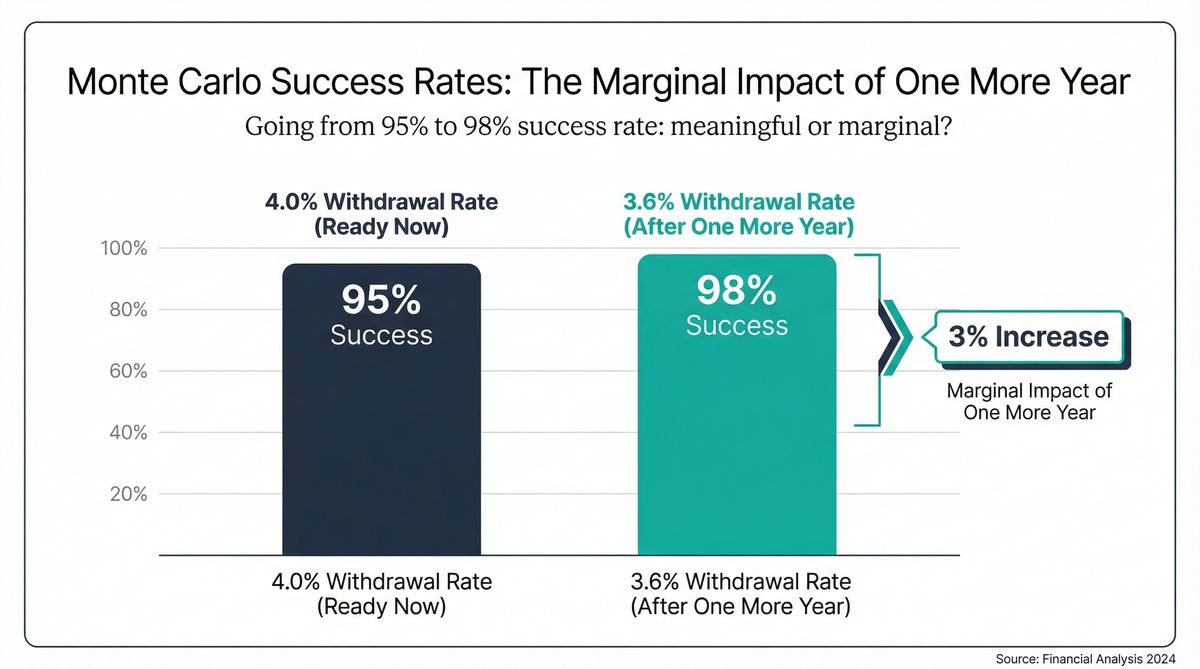
Say you've stacked $1.2 million and you spend $48,000 a year. That's a 4% withdrawal rate — right at the benchmark Bill Bengen established back in 1994. You're 58 years old.
You work one more year, save another $40,000, and your portfolio grows around 7%. You end up with roughly $1.32 million.
Your withdrawal rate drops from 4.0% to 3.6%. That's... cool, I guess. But here's the part nobody talks about: you were already going to be fine. Going from a 95% success rate in Monte Carlo simulations to 98% isn't a meaningful improvement in your actual life. It's a rounding error dressed up as being responsible.
Meanwhile, what did that year actually cost?
The Real Cost of "One More Year"
365 days of commuting, office nonsense, and Sunday-night dread. If you're 58 with your healthiest years running to your mid-to-late 70s, you just burned 5–6% of your best years for a marginal improvement in a plan that was already solid. That's a terrible trade.
What One More Year Actually Costs (The Stuff You Can't Get Back)
Financial planners love to talk about the upside of working longer. More savings. More Social Security credits. One less year of drawing down your stacks.
Almost nobody talks about the downside. So let me.
Your Health Has an Expiration Date
The difference between retiring at 58 and 60 might seem like nothing on a spreadsheet. But talk to anyone who developed a chronic health issue at 62 and they'll tell you those two years of hiking, traveling, and hanging with grandkids would have been priceless. You can't bank health for later. Trust me on this one.
There's actually a big study of French workers (the GAZEL cohort) that found health — especially mental health and fatigue — improved a ton in the years right after retirement. Other research has found that prolonged work stress messes with your health in later life. The body keeps score even when the spreadsheet doesn't.
Relationships Don't Wait Around
Your spouse has been patient. Your kids are growing up. Your parents are aging. Every "one more year" is a year your partner spends alone, a year your grandkids get older, a year your aging parents may or may not still be around. These aren't hypotheticals — they're the things people regret most at the end. I've seen it.
Your Energy Is Declining Right Now
There's a reason retirement planners talk about "go-go years" (active early retirement), "slow-go years" (less active), and "no-go years" (limited mobility). Every year you delay shifts money from a phase where you'll actually use it into phases where you probably won't. You're basically choosing to be richer at 85 and poorer at 62. Think about that.
That trip to Patagonia you've been dreaming about requires a level of fitness that has a shelf life. Money is fungible. Time and health are not.
Here's how I think about it: that trip to Patagonia you've been dreaming about requires a level of fitness that has a shelf life. The cross-country road trip with your spouse hits different at 60 than it does at 70. Lindsay and I learned this living out of a caravan in Europe — you want to do these things when your body is still saying yes. Money is fungible. Time and health are not.
The Psychological Transition Gets Harder, Not Easier
Here's the cruel part: the longer you stay, the harder it becomes to leave. Your identity fuses more deeply with your job. Your social circle stays work-centered. The gap between "employed person" and "retired person" grows wider and scarier. OMY syndrome doesn't cure itself — it feeds itself. People who are afraid to retire today will be more afraid to retire next year.
A Retirement Decision Framework: The Five Fears Behind Every "One More Year"
When I dig beneath the surface with someone stuck in the OMY loop, it usually comes down to one of these five fears. Understanding them is the first step in any real retirement decision framework.
1. "What if the market tanks right after I retire?"
📉 Sequence-of-Returns Risk
The risk that poor investment returns early in retirement will permanently damage your portfolio, even if later returns are average or above. It's real — but it's fixable with a cash buffer, flexible withdrawal strategy, and conservative early-year allocation.
This is sequence-of-returns risk. It's real — but it's also fixable. A cash buffer covering 1–2 years of expenses, a flexible withdrawal strategy (you cut the fun spending in down years), and a conservative allocation for the first few years handles this. You don't need to work forever. If your plan can't survive one bad year, the fix isn't "never retire" — it's "fix the plan."
Use a tool like our chance of success calculator to stress-test your numbers against historical worst-case scenarios. That's how you replace vague anxiety with actual data.
2. "What if I run out of money at 87?"
Run the numbers with conservative assumptions. 4–5% real returns on a balanced portfolio, inflation at 3%, spending modeled to age 95. If it works, it works. No amount of "one more year" is going to eliminate the existential dread of an uncertain future. At some point, that's not a math problem — it's an anxiety problem. And I say that with love.
A solid retirement budget planner can show you exactly what your spending looks like decade by decade — so you stop guessing and start knowing.
3. "What will I actually DO all day?"
This one's real, and it doesn't get enough airtime. Research consistently shows that the retirees who struggle most aren't the ones with less money — they're the ones who never built a life outside of work.
But the answer isn't to keep grinding at a job you want to leave. The answer is to build a life worth retiring into — not just a job worth retiring from. Start now, while you're still working. Volunteer somewhere. Pick up hobbies. Reconnect with people you've been meaning to call. Join a pickleball league. Take a community college class. Whatever. The transition is rough for people who never thought about it, and smooth for people who planned for it even a little bit. My friend Rosa in Barcelona would tell you — the best things in life don't cost much, but they do require you to actually show up for them.
4. "Healthcare before Medicare worries me to death."
If you're retiring before 65, this is a real cost and it deserves a real plan — not hand-waving.
🏥 Pre-Medicare Healthcare Options
ACA Marketplace: ~$15,000–$25,000/year for a couple. Can't deny pre-existing conditions. Income-based subsidies available.
COBRA: Bridges up to 18 months post-employer. Typically expensive (full premium + 2% admin fee).
Key strategy: Manage your income through smart Roth conversions and capital gains harvesting to maximize ACA subsidies.
It's a real cost. Budget for it. But it's a known, solvable cost — not a reason to work five more years.
5. "My identity IS my work."
This is the deepest one, and the hardest to admit. If your entire sense of self-worth is wrapped up in your job title and what you've accomplished professionally, retirement feels like a kind of erasure. I get it.
But that's not a financial problem. That's a you problem. And another year of working isn't going to solve it — it's going to make it worse. I used to keep my career and social life completely separate because I never wanted to be defined by my work. I see much more to life than that. Work is what we do to pay for the lives we actually want to live.
The Hidden Upside Nobody Talks About: Tax-Optimized Early Retirement
Most OMY conversations focus on what you're giving up (a paycheck) or avoiding (risk). But there's a money angle that rarely gets discussed: the early retirement years from roughly 58 to 65 are some of the most valuable years for tax planning.
If you retire before collecting Social Security and have most of your bread in traditional 401(k)/IRA accounts, those low-income years are a golden window for Roth conversions. You can systematically convert traditional retirement funds to Roth at a fraction of the tax rate you'd pay later — when Required Minimum Distributions, Social Security, and possibly a surviving spouse's bracket changes could push you way higher.
The Roth Conversion Window
Early retirement years (58–65) offer potentially tens of thousands of dollars in lifetime tax savings through low-bracket Roth conversions — a window you lose every year you keep working.
That's not just "free time" — it's potentially tens of thousands of dollars in lifetime tax savings that you only get by retiring early enough to use the window. That's real money left on the table every year you keep working. Our tax and benefits optimization tools can help you map out exactly how much you stand to save.
Is It Strategy or Is It Fear? A Framework for Your When-to-Retire Decision
Not every case of one more year syndrome is irrational. Sometimes another year genuinely makes sense. Here's a retirement decision framework to tell the difference.
✅ Probably a Smart Move
- You're within 1–2 years of a meaningful pension milestone or vesting event
- You genuinely enjoy your work and aren't just afraid to leave
- You have a specific, measurable goal ("I need $X more for the healthcare bridge to 65")
- Your health is excellent and the job isn't messing you up
- Your spouse/partner is aligned and not resentful
- You're waiting for a Social Security age threshold that meaningfully changes your plan
🚩 Probably Fear Talking
- You've moved the goalpost more than once
- Your "number" keeps changing and you can't really explain why
- You can't articulate what specific risk one more year eliminates
- Your spouse, advisor, or friends have all told you you're ready
- You feel relief on Friday and dread on Sunday
- You're staying for the paycheck but the job is wrecking your health or relationships
- You daydream about retirement constantly but can't commit to a date
If someone offered you your current salary to NOT work for a year — to travel, pick up hobbies, spend time with family — would you take it? If yes, you don't have a money problem. You have a courage problem.
The Exercise That Changes Everything
Try this. Sit down with a blank page and answer three questions honestly:
- What specifically would one more year buy me? Write the actual number. Not "peace of mind" — a dollar amount and what it actually changes in your plan.
- What will one more year cost me? Be honest with yourself. Your health trajectory. Your relationships. Your energy for the things you've been saying you want to do. Time with aging parents. Missed experiences. And yeah — a year of that valuable Roth conversion window, gone.
- If I knew with 100% certainty that my plan would work, would I leave tomorrow? If yes, then your problem isn't financial — it's psychological. And the solution isn't more money. It's looking the fear in the face and dealing with it.
Most people who do this exercise honestly realize the math case for staying is thin. The real case for staying is emotional — and once you name the emotion, it loses most of its power.
Making the Leap
The retirement planning world has a massive blind spot. We've got incredible tools for stacking your bread — budgeting apps, investment calculators, Monte Carlo simulations, tax optimization strategies. Boldin and ProjectionLab can model your finances down to the penny.
But none of them can tell you when you're ready. That's a human question, not a math question. And it's the one that actually matters.
At Ready Aim Retire, this is something we think about a lot — the gap between financial readiness and emotional readiness. Because we've seen too many people sacrifice their best years at the altar of "just to be safe."
Our holistic retirement timeline helps you see the full picture — not just the money, but the life milestones, health windows, and relationship moments that make up a real retirement plan.
The spreadsheet already told you the answer. The question is whether you're going to trust it.
Your Move
If you've been circling the OMY drain, here's my challenge: pick a date. Not "sometime next year." Not "after this project wraps up." An actual date on an actual calendar. Write it down. Tell your spouse. Tell your financial advisor. Tell a friend who'll hold you to it.
You don't have to commit to it forever. But you need something concrete to plan toward, or "one more year" will quietly become "one more decade."
The money will almost certainly be fine. The real risk isn't running out of money at 85.
It's running out of time at 65 and realizing you spent your healthiest years solving a problem that was already solved.
Peace!
Your Next Steps
- Stress-test your numbers. Use a Monte Carlo calculator with conservative assumptions. If you're above 90% success rate, you're likely ready.
- Do the three-question exercise. What does one more year buy? What does it cost? Would you leave if the plan was guaranteed? Write it down.
- Map your Roth conversion window. Use our tax optimization tools to see how much you're leaving on the table each year you delay.
- Build your retirement life now. Start hobbies, volunteer work, and social connections before you leave — the transition is dramatically easier.
- Pick a date. Put it on the calendar. Tell someone who'll hold you to it. Make it real.
- Create your holistic retirement timeline. See the full picture — money, health windows, relationships, and life milestones together.
Thinking about your own retirement timeline? Ready Aim Retire helps people navigate not just the financial side, but the human side of retirement planning — including knowing when "enough" is actually enough.