How Moving to a Different State Can Add 10 Years to Your Retirement Money
I have friends — let's call them Mike and Laura — who retired in 2023 with $1.2 million saved up. That's a hefty number. They worked hard for it. And they figured they were set.

Then they actually ran the math on their life in suburban LA.
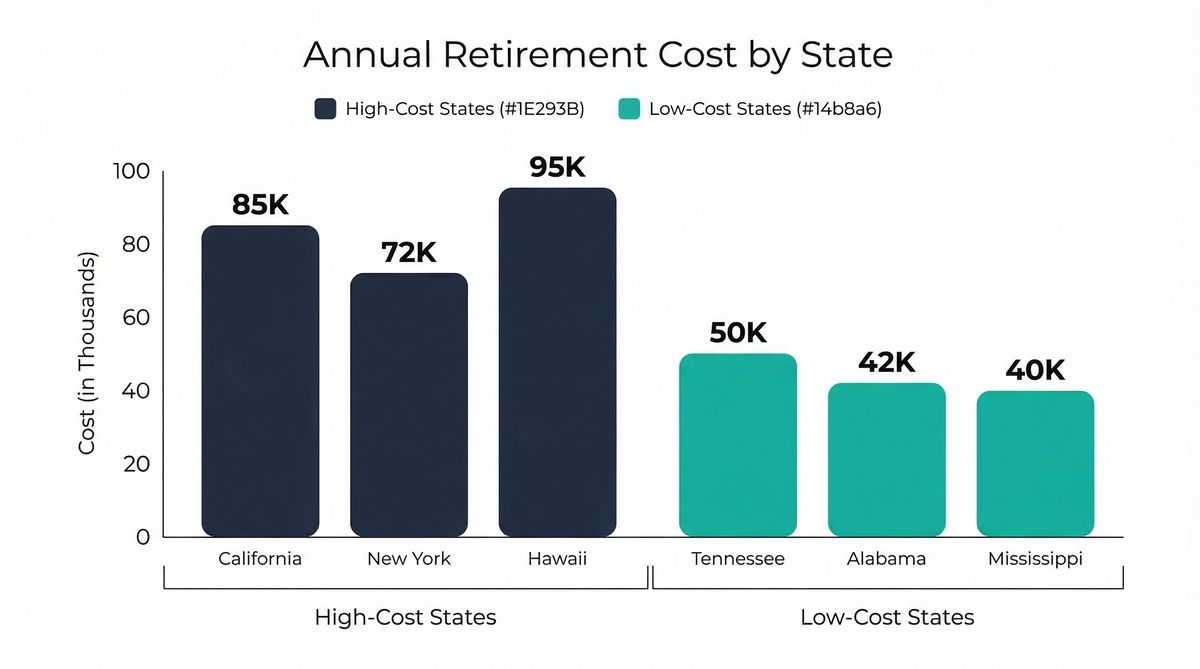
California income tax (up to 13.3%), property taxes on a pretty average three-bedroom, healthcare supplements, and just the general cost of existing in Southern California — they were blowing through $85,000 a year. That's a 7.1% withdrawal rate. At that pace, they'd be broke by their mid-70s.
So they moved to Knoxville, Tennessee.
Same lifestyle. A nicer house with more yard. Annual spending dropped to $50,000. Withdrawal rate fell to 4.2%. Their money can now realistically last into their late 80s or beyond.
Same couple. Same stacks. Same retirement. A decade-plus of extra financial security — just from changing their zip code.
That's retirement geographic arbitrage. And it might be the single most powerful money move you can make heading into retirement.
Moving from a high-cost to low-cost state can dramatically extend your portfolio's lifespan:
- The difference: Same lifestyle costs $40K-45K/year in cheap states vs. $85K-100K+ in expensive ones
- Portfolio impact: This difference can add 10-20 years to your retirement money
- Nine states have zero income tax: Alaska, Florida, Nevada, New Hampshire, South Dakota, Tennessee, Texas, Washington, Wyoming
- Beyond taxes: Consider property taxes, housing costs, healthcare access, and quality of life
Geographic arbitrage isn't about penny-pinching — it's a withdrawal rate strategy that can transform your retirement security.
Why Most "Best States to Retire" Lists Get It Wrong
Go ahead, Google "best states retire taxes".
You'll find Bankrate's list. Kiplinger's list. Motley Fool, SmartAsset — everybody and their mother has a ranked list with cute little checkmarks next to "tax-friendly" features.
Here's the problem: those lists treat picking a state like choosing a vacation destination. Weather? Check. Near the grandkids? Check. Florida has no income tax? Slap a gold star on it and call it a day.
What nobody does is connect where you live to how long your money actually lasts. And that connection is the whole ballgame.
The difference between retiring in a high-cost state versus one of the cheapest states to retire can literally be the difference between your portfolio carrying you for 12 years or 30-plus.
That's not a lifestyle decision. That's a "do I run out of money" decision.
The Real Cost Difference: State-by-State Retirement Math
Let's keep this simple.
A comfortable retirement in Mississippi, Arkansas, or West Virginia costs roughly $40,000 to $45,000 a year. That same lifestyle — same groceries, same type of house, going out to eat the same amount — runs $85,000 to $100,000+ in Hawaii, California, or New York.
That's a $40,000 to $55,000 gap. For the exact same quality of life.
The Portfolio Math That Changes Everything
Every $10,000 you cut from annual spending can add roughly 3 to 5 years of portfolio life, depending on market returns and how you're invested. Moving from a pricey state to an affordable one can easily knock $25,000 to $40,000 off your annual nut.
Now throw a portfolio at it. Say you've saved $1 million — a number a lot of Americans are chasing but few actually hit, which makes being smart with it even more important.
High-Cost State Scenario
- Annual Spending $80,000
- Withdrawal Rate 8.0%
- Portfolio Lasts ~12 years
Low-Cost State Scenario
- Annual Spending $45,000
- Withdrawal Rate 4.5%
- Portfolio Lasts 30+ years
Same million dollars. One scenario runs dry at 77. The other carries you past 95.
This is why I think about geographic arbitrage not as penny-pinching, but as a withdrawal rate strategy. It's one of the few moves you can make that completely changes your retirement math without going back to work or living like a monk.
State Tax Retirement Planning: The Four Factors That Actually Matter
Most people only think about housing prices when they think about cost of living. But state tax retirement planning breaks down into four big buckets, and you gotta look at all of them.
State Income Taxes: The Best (and Worst) States for Retirees
Nine states charge zero income tax: Alaska, Florida, Nevada, New Hampshire, South Dakota, Tennessee, Texas, Washington, and Wyoming.
Important Note
"No income tax" doesn't always mean "no tax on your investment gains." Washington, for example, hits you with a 7% capital gains tax on long-term gains over about $278,000 (indexed yearly), and 9.9% on gains above $1 million. If you're selling appreciated assets or managing a solid portfolio, that bites. Washington also passed a 9.9% tax on income over $1 million starting in 2028, which faces a court challenge and a possible repeal vote. And New Hampshire just made this list by killing their Interest & Dividends tax as of January 1, 2025.
Here's where it gets interesting. A few states technically have income tax but effectively don't tax retirement income. Illinois, Mississippi, and Pennsylvania fully exempt 401(k), IRA, and pension income. Iowa does the same if you're 55 or older.
Meanwhile, some states that seem tax-friendly still tax Social Security: Colorado, Connecticut, Minnesota, Montana, New Mexico, Rhode Island, Utah, and Vermont. If Social Security is a big chunk of your retirement bread, pay attention. Most of those states offer partial exemptions based on income, but the thresholds are all over the place — check the specifics for your situation.
Property Taxes: The Sneaky Cost That Destroys Retirement Budgets
This is where people get burned. Especially folks who get starry-eyed over "no income tax" states.
Texas is the perfect example. No state income tax sounds incredible. But a $350,000 house in Texas can easily run you $7,000 to $10,000 a year in property taxes. A similar home in Tennessee? $2,000 to $3,000.
| State | Median Property Tax | Difference from Cheapest |
|---|---|---|
| New Jersey | $9,358 | +$8,468 |
| Texas | $7,500 | +$6,610 |
| Tennessee | $2,500 | +$1,610 |
| Alabama | $890 | Baseline |
The extremes are nuts. New Jersey's median annual property tax is $9,358. Alabama's? About $890. That's an $8,468 difference every single year — on a median-value home. Every. Year.
Housing Costs in the Cheapest States to Retire
If you own a home in an expensive market, selling and buying somewhere cheaper can dump a serious chunk of cash into your retirement portfolio.
West Virginia's median home price is around $147,000. Mississippi, Louisiana, Kentucky, and Arkansas are in the same neighborhood.
Picture this: you sell an $800,000 house in the Bay Area and buy a $200,000 place in a mid-sized Tennessee city. That's $600,000 freed up. After agent commissions, closing costs, and moving expenses — call it $550,000 added straight to your retirement investments. On top of all the lower ongoing costs.
For somebody worried about whether their savings will last? That's life-changing money.
Healthcare Costs and Access by State
Medicare is federal, so your basic coverage follows you. But Medigap and Part D premiums vary by state and insurer. And here's the thing nobody puts in the brochure — healthcare quality and access vary too.
Some of the cheapest states to retire in don't have the same medical infrastructure as pricier areas. If you've got chronic health conditions or might need specialized care, picking a state purely because it's cheap could come back to bite you.
Smart move: target affordable metro areas. Cities like Knoxville, Huntsville, Tulsa, or Fayetteville, Arkansas — lower costs than coastal cities but with solid hospital systems and specialists nearby.
Retirement Geographic Arbitrage in Action: Real Scenarios
The California-to-Tennessee Move
Couple, both 65. $1.2 million portfolio.
In California, they're spending $85,000 a year. Mortgage is paid off, but between property taxes, state income tax, insurance, groceries, and gas, it adds up fast. Withdrawal rate: 7.1%. Historical data says that portfolio dies around age 77 or 78.
They sell their California house for $750,000. Buy a comparable place near Nashville for $280,000. Add $430,000 (after transaction costs) to their portfolio. New total: about $1.63 million. Annual spending in Tennessee: $50,000. No state income tax. Lower property taxes. Lower everything.
New withdrawal rate: 3.1%. Their money could realistically last 35+ years. They'll almost certainly never run out.
Same couple. Just a different address.
The New York-to-Alabama Move
Single retiree, 63 years old. $800,000 portfolio.
In New York, costs are $72,000 a year. That's a 9% withdrawal rate — basically a countdown clock. Portfolio might last 10 to 11 years. Serious trouble by mid-70s.
In Alabama, same lifestyle costs about $42,000. Property taxes are dirt cheap. Alabama doesn't tax Social Security or pension income. Withdrawal rate drops to 5.25%.
Still above the classic 4% rule, but combined with Social Security (which reduces what you're pulling from the portfolio), the math starts working. That move potentially adds 10-plus years of not worrying about money.
When "No Income Tax" Backfires: A Cautionary Tale
Here's one that'll make you think twice.
A retiree leaves Illinois for Texas, pumped about ditching state income tax. But they didn't do the homework.
Here's the thing about Illinois — it already exempts retirement income from state taxes. So this person wasn't really paying much state income tax to begin with.
Meanwhile, their shiny new Texas home comes with a $9,200 annual property tax bill. Compared to $4,500 back in Illinois. Homeowner's insurance is higher too, thanks to storm risk.
Net result: they're paying more in total annual costs. The "no income tax" label was a head fake.
Bottom line: never look at one tax in isolation. You gotta model the total annual cost — income taxes, property taxes, sales tax, housing, insurance, healthcare, groceries, utilities — all of it. A solid retirement calculator can help you compare scenarios side by side.
Beyond the Spreadsheet: What Your Tax Calculator Won't Tell You
The math matters. But it's only part of the story. And I've seen people make this mistake over and over.
Retirees who move purely for financial reasons — without really thinking about their social life — often end up regretting it within a couple years. Saving $30,000 a year doesn't do you much good if you're lonely and miserable. Trust me on this one.
Before you start browsing Zillow in Huntsville, think about:
Your people. Where are your friends? Your family? Your crew? Social connections get more important in retirement, not less. Loneliness is a real health risk as you get older. This isn't fluffy self-help stuff — it's documented.
Hidden costs in "cheap" states. Florida's sunshine comes with hurricane insurance premiums that can run $3,000 to $5,000+ a year. Tornado alley has its own weather fun and insurance costs. Some low-cost rural areas mean you need a car for literally everything — fuel, maintenance, eventually a new car. That adds up.
Try before you buy. Rent in your target area for three to six months before you commit. Experience the summers. Experience the winters. Experience the random Tuesday afternoon when you don't know a soul and your closest friend is 800 miles away. Make sure it works for your life, not just your spreadsheet.
The snowbird move. Some retirees set up residency in a tax-friendly state while spending chunks of the year elsewhere. Split time between a low-cost home base and seasonal rentals — you get most of the financial benefits with more flexibility. Just know the rules: many states want you physically present 183+ days a year to count as a resident. And your old state might still try to claim you if you don't clearly cut ties.
Estate and inheritance taxes. This one sneaks up on people. Twelve states plus D.C. have estate taxes. Five states have inheritance taxes. If leaving something behind for your kids matters to you, put this on the list.
🎯 Your Geographic Arbitrage Action Plan
- Calculate your current total annual retirement cost: Not just taxes — everything. Housing, property tax, insurance, healthcare, utilities, food, gas, fun. All of it. Use our retirement calculator to map this out.
- Research target states thoroughly: Pick two or three of the best states to retire for taxes and lifestyle, then estimate those same costs there. Don't just compare state tax rates — be thorough.
- Model the portfolio impact: What does your withdrawal rate look like in each scenario? How many extra years does your money last?
- Test before committing: If the numbers show a real difference (we're talking $15,000+ a year), visit. Rent for a while. Talk to people who've made the move. Make sure it works for your life, not just your spreadsheet.
The Bottom Line on Retirement Geographic Arbitrage
You can't control the stock market. You can't control inflation. You can't control what healthcare costs at the national level.
But you can control where you live. And that one choice might matter more for your retirement security than any investment you'll ever make.
A $1 million portfolio at an 8% withdrawal rate in San Francisco? That's a ticking time bomb. That same million at 4% in Knoxville? That's a comfortable, sustainable retirement.
Same money. Different zip code. Completely different life.
That's geographic arbitrage. And honestly, more people should be talking about it.
Peace.