When It Doesn't Make Sense to Use the 4% Rule


Here's something almost nobody tells you about the 4% rule, the most famous number in retirement planning. It was never meant to be a target. It was a floor. A worst-case, batten-down-the-hatches number, calculated for the single unluckiest retiree in modern history.
- It's a floor, not a target: Only one retiree in William Bengen's original study was ever held down to 4% — everyone else could have safely spent more
- Even Bengen moved off it: His 2025 research supports 4.7%, and he calls 5% "feasible"
- The bigger risk is underspending: More retirees die with too much money than run out of it
- Your real number depends on you: Time horizon, guaranteed income, taxes, and the market you retire into can reasonably swing the safe rate from about 3% to 6%+
Bottom line: the 4% rule is a decent gut check, not a retirement plan. Your number isn't the number.
Let that sink in for a second.
Back in 1994, a financial planner named William Bengen ran every 30-year retirement window going back to 1926 and asked one simple question. How much could you have pulled out each year, bumped up for inflation, and still not run out of money? He looked at more than 400 retirees. And the answer, on average, was somewhere around 7%. Only one person in all of that history, the poor soul who retired in 1966 right before a decade of stagflation kicked him in the teeth, was actually held down to about 4%. Bengen even gave that worst-case number a name. He called it SAFEMAX, and it came out to 4.15%. Everybody else could have spent way more and been just fine.
Bengen has spent three decades since then trying to clear up the confusion. In 2025 he put out a book called A Richer Retirement, and in it he bumped his own safe number up to 4.7%. That's a 17.5% raise, and it turns a $40,000 withdrawal on a $1 million portfolio into $47,000. He now says 5% is "feasible." He calls the original figure "more of a guideline than a strict rule." He even told CNBC that early retirees who cling to it "may be cheating themselves."
So here's the part that stings if you're planning your own retirement income. The 4% rule can fail in two directions. Sure, once in a blue moon it can let somebody run out of money. But way more often, it does the exact opposite. It scares perfectly healthy savers into spending too little, so they sit on the retirement they spent forty years building and then die with more money than they walked in with.
The 4% rule in one paragraph, so we can see where it cracks
Here's the whole thing. The 4% rule says take 4% of your portfolio in year one, then give yourself an inflation raise every year after that, no matter what the markets are doing. It assumes you're retired for 30 years, that you're holding roughly 50 to 60% stocks and 40 to 50% bonds, and that the future looks like U.S. history. Count up all those assumptions. Now change just one of them. Your time horizon, your income sources, how your spending actually flows, the market you happen to retire into. Change any single one and that tidy little 4% figure stops describing you.
The 4% Rule's Fine Print
The 4.15% SAFEMAX figure only holds if all three of these are true: a 30-year retirement horizon, a portfolio of roughly 50–60% stocks and 40–50% bonds, and a future that resembles U.S. market history since 1926. Change any one assumption and the number stops applying to you.
It was one answer to one specific set of conditions. And your conditions are almost certainly different. You can run these numbers for your own situation at ReadyAimRetire.com instead of borrowing assumptions that were built for someone else's retirement entirely.
The bigger danger isn't running out. It's dying rich and miserable.
Let me paint you a picture. Say there's a couple, we'll call them Jim and Carol, and they've got $2 million. They follow the rule to the letter. They take $80,000 a year, adjusted for inflation, and they never once waver. They skip the river cruise at 68 because the market had a rough spring. They keep driving the old sedan another three years. They're careful, they're disciplined, and honestly, they're a little scared the whole way through.
Then they pass away at 88 with $2.4 million still sitting in the account.
Real-World Example: Jim and Carol's $2.4 Million Mistake
By the rule's own scorecard, Jim and Carol's retirement "worked." They never ran out of money. But they also never took the trips, never spoiled the grandkids the way they always talked about, and never spent during the go-go years when they still had the knees and the energy to enjoy it.
The 4% rule cost Jim and Carol the retirement they paid for, and it did it quietly, one nervous little decision at a time.
This is the part most other articles skip right past. They frame the whole risk around running out of money. But the math says the more common ending, for anybody with a normal or better-than-normal portfolio, is leaving a small fortune on the table. If that sounds like you, 4% isn't protecting you. It's rationing you.
Seven retirees for whom 4% is simply the wrong number
The rule assumes an "average" retiree who doesn't really exist. Here's where actual people walk away from it.
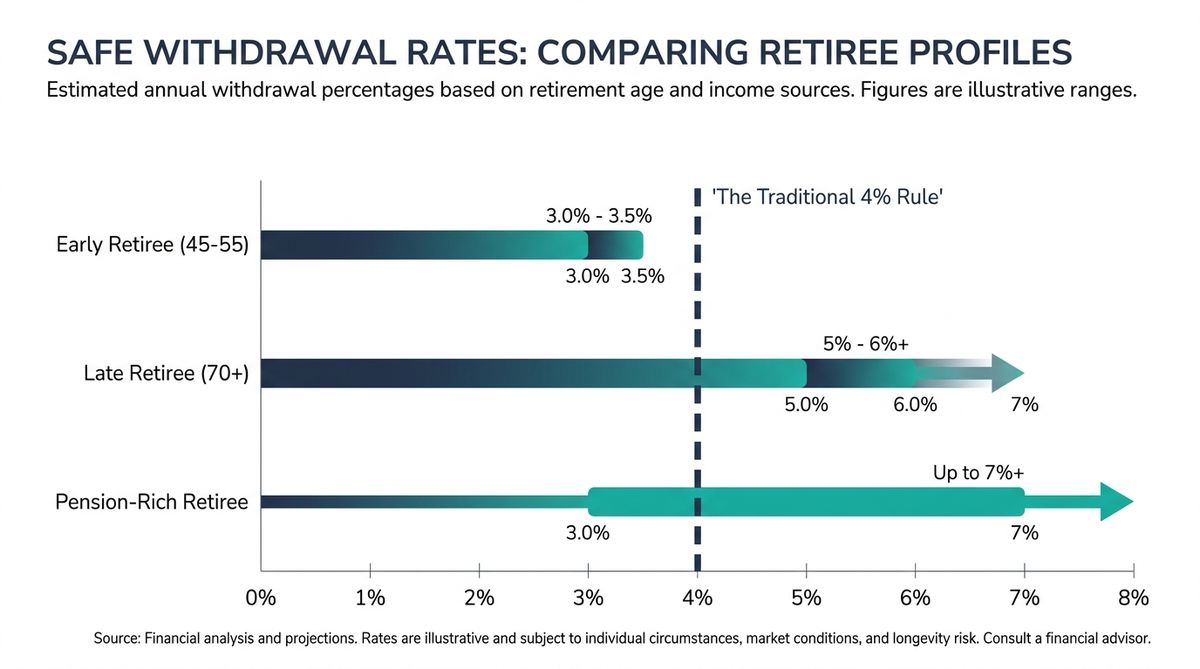
| Retiree Profile | Why 4% Breaks Down | More Realistic Starting Rate |
|---|---|---|
| Early retiree, 45–55 | A 30-year rule can't run a 45- to 50-year retirement | ~3.0%–3.5% |
| Late retiree, 70+ | Doesn't need the money to last 30 years | 5%–6%+ |
| Pension/Social Security-rich | Guaranteed income already covers essentials | Up to ~7% on remaining assets |
| Retiring into today's market | CAPE near 40 raises sequence-of-returns risk | More caution in the first years |
| Spending won't be flat | Real spending drifts down through retirement | Front-load, taper later |
| Tax-heavy, RMD-bound | 4% is pre-tax; RMDs can force withdrawals higher | Plan around after-tax income |
| Facing a spending shock | No room for lumpy one-time costs | Keep a separate reserve |
The early retiree, age 45 to 55
A 30-year rule just can't run a 45 or 50-year retirement. The FIRE crowd tends to land closer to 3.0 to 3.5%, and even Bengen himself suggests around 4.3% for a 50-year stretch. Retire at 50 with $1.5 million and 4% ($60,000) might not make it across 45 years, while 3.25% ($48,750) very likely will. Leave work early and the standard number is just too aggressive for you — if that's the boat you're in, here's a fuller game plan for retiring in your 50s.
The late retiree, age 70 and up
Flip that around and 4% turns needlessly tight. Somebody retiring at 72 doesn't need the money to last 30 years, so anchoring to a 30-year floor just leaves real spending sitting there unused. A 5 to 6% starting rate is often perfectly reasonable, and that can mean thousands more each year of the retirement you actually get to live.
The pension or Social Security-rich retiree
This one almost never gets explained properly, so pay attention. If guaranteed income covers most of your essential bills, a market crash can't touch your must-pay budget, which means your portfolio can take on a lot more risk. As guaranteed income grows from a small slice of your wealth toward the biggest slice, the research shows your safe starting draw on whatever's left can climb by more than four percentage points, maybe up toward 7%. If your pension and Social Security already cover the mortgage, the groceries, and the electric bill, then pulling a rigid 4% out of your investments on top of all that might leave you drastically underspending.
Anyone retiring into today's market
By late 2025, the Shiller CAPE ratio, which is basically a gauge of how pricey stocks are, had climbed to nearly 40. That's a level the U.S. market has only hit one other time, at the peak of the dot-com bubble back in 1999. Vanguard figures on roughly 4% ten-year returns for high-quality bonds and below-average returns for U.S. stocks, given how stretched those prices are. High valuations plus a rough first year or two is the textbook recipe for what the pros call sequence of returns risk. That's when early losses do permanent damage, because you're selling shares right as they're falling. Think about it this way. The lucky fella who retired in 1982 and the unlucky one who retired in 2000 followed the exact same rule and ended up in totally different places. The difference was timing, not discipline.
The retiree whose spending won't be flat
The rule assumes you spend the same inflation-adjusted amount at 85 that you did at 65. Real retirees just don't. A researcher named David Blanchett found that spending actually drifts down through retirement. A household starting at $100,000 a year eases down to about $74,000 by age 84. That's a 26% drop in real terms, before a possible healthcare bump late in life. It's the old "go-go, slow-go, no-go" arc. A flat line overshoots your quiet later years and shortchanges the busy early ones when you most want the cash.
The tax-heavy, RMD-bound retiree
Remember, the 4% figure is before taxes. Pull $40,000 out of a traditional IRA and it gets taxed as ordinary income, so depending on your bracket you might only keep $32,000 to $36,000 of it. Even less if that withdrawal stacks on top of Social Security and other income. Then at 73 (moving up to 75 in 2033), required minimum distributions can force you to pull out more than 4% whether you like it or not. If most of your savings are sitting in traditional accounts, the rule doesn't describe your real spending power or your real withdrawals.
The retiree who hits a spending shock
The rule has no room for the big lumpy expenses. One year of nursing home care runs $114,975 for a semi-private room and $129,575 for a private one, according to the 2025 Genworth/CareScout survey. Assisted living averages $74,400 a year, and in-home care runs around $80,080. A new roof, a replacement car, a health scare. None of that fits inside a smooth little 4% line, and pretending it will is exactly how plans fall apart.
If you saw yourself in more than one of those, well, that's kind of the whole point. The rule doesn't fit most people cleanly, because it was never built to.
Why even the experts can't agree on the safe withdrawal rate
Here's a wrinkle worth understanding, because it explains why you'll see wildly different numbers thrown around like gospel.
Bengen now says 4.7%. Morningstar's 2026 base case says 3.9%, which is actually below the original 4%. That's a big gap between two credible sources, and it's not because one of them is wrong.
Bengen: Looking Backward
- Method Backtests actual U.S. returns since 1926
- Current Safe Rate 4.7%
- Ceiling 5% "feasible"
- Bias Generous
Morningstar: Looking Forward
- Method Monte Carlo on today's valuations
- 2026 Base Case 3.9%
- Success Target 90%
- Bias Cautious
The difference is method. Bengen looks backward, running the actual U.S. return history, and that history includes some genuinely fantastic decades. Morningstar looks forward, running Monte Carlo simulations that bake in today's high prices and lower expected returns, then aims for a 90% success rate. Looking backward is generous. Looking forward is cautious. That's the whole story.
The lesson isn't to pick a team. It's that a single number can't survive contact with two reasonable approaches, let alone your actual life. Morningstar says it well.
Your safe withdrawal rate depends on your plan, not an average.
Their own range of defensible starting rates runs from about 2% in a worst case up to 5.7% with flexible strategies. That spread, 2% to nearly 6%, is the real answer. The tidy 4% headline just hides it. Every retirement plan is different, and ReadyAimRetire lets you test how these strategies play out with your specific numbers instead of guessing which camp you fall into.
What to do instead of the 4% rule
Now here's the good news. The alternatives aren't fancy or complicated, and most of them let you spend more, not less.
Use dynamic guardrails
Instead of the same raise every single year, you set guardrails. Spend a little more after strong years, trim a little after bad ones. In one worst-case simulation, the static 4% rule succeeded 82% of the time, while Guyton-Klinger guardrails starting at 5% succeeded 93% and spent more along the way. There's a real tradeoff, though. Classic guardrails can force some painful cuts, as much as 54% below plan for a stagflation-era retiree in Michael Kitces's analysis. That's exactly why the gentler "risk-based" versions that soften those cuts are worth asking a planner about.
Start from Bengen's updated figure for a standard retirement
For a regular old 30-year horizon with a diversified portfolio, his current work supports 4.7%, and he thinks 5% is feasible. Right there, that's a meaningful raise over the old number.
Build a bond tent or cash bucket
Keep one to three years of spending in cash and short-term bonds so you never have to sell stocks into a downturn. This is your direct defense against that sequence-of-returns risk that makes the early years so dangerous.
Floor your essentials with guaranteed income
Cover your must-pay bills with Social Security, a pension, or an annuity, then spend flexibly from the portfolio on top of that. When the mortgage is covered no matter what the market does, a scary year in stocks turns into an annoyance instead of an emergency.
Re-plan every year
Rather than locking in one year-one number for the rest of your life, recompute based on where you are now. Your current balance, your current age, your current spending. A 4% draw on a portfolio that has doubled is a completely different dollar figure, and pretending otherwise is exactly how retirees end up hoarding. Start by modeling your retirement at ReadyAimRetire and rerunning it whenever your balance or your plans change.
Five Ways to Replace the 4% Rule
- Dynamic guardrails: Spend more after good years, trim after bad ones
- Bengen's updated rate: 4.7% for a standard 30-year retirement
- Bond tent or cash bucket: 1–3 years of spending held outside the market
- Floor your essentials: Cover must-pay bills with guaranteed income first
- Re-plan annually: Recompute your rate off your current balance, not year one
Your number, not the number
The 4% rule earned its fame fair and square. It's clean, it's memorable, and as a quick gut check it still has value — one of several handy rules of thumb for figuring out how much you need to retire. If you honestly have no idea whether you've saved enough, then "is my annual need less than 4% of my portfolio?" is a perfectly reasonable first pass.
But a gut check is not a spending plan, and a worst-case floor from 1994 is not your ceiling. Bengen himself moved off the number. The honest range, once you factor in your horizon, your guaranteed income, your taxes, your real spending curve, and the market you're actually retiring into, runs from roughly 3% for a 50-year-old up to 6% or more for a well-covered 72-year-old.
So here's what I'd do. Write down your time horizon. Add up your guaranteed income. Mark which of your expenses are essential and which are just nice-to-haves. Note how much of your money is sitting in taxable accounts. Then find your own safe withdrawal rate somewhere in that 3-to-6% range, and promise yourself you'll revisit it every year instead of once and never again. That one habit, planning from your actual life instead of from a slogan, is worth more than any number you could ever memorize.
The rule was built to keep the unluckiest retiree in history from going broke. You are almost certainly not that person.
So plan like it.
Thanks for reading if you've made it this far. Peace!